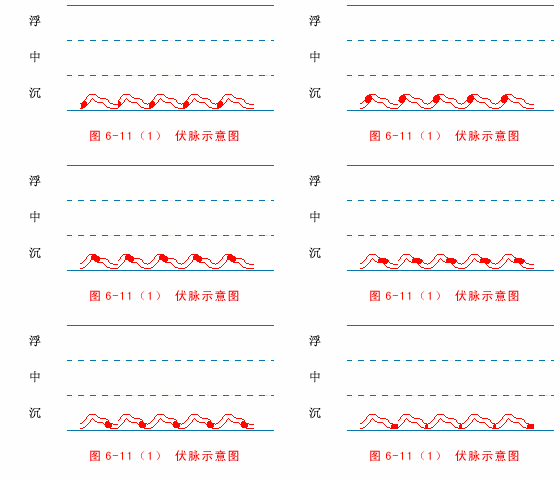
Hidden Pulse
伏脉
Hidden Pulse (伏脉)
Appearance (体象歌)
伏为隐伏,更下于沉;推筋著骨,始得其形。
Clinical Indications (主病歌)
伏脉为阴,受病入深。伏犯左寸,血郁之证;伏居右寸,气郁之疴。左关值伏,肝血在腹;右关值伏,寒凝水谷。左尺伏见,疝瘕可验;右尺伏藏,少火消亡。
Clinical Significance
The Hidden Pulse indicates deep-lying yin pathogens and disease entering deeply into the interior. It is located deeper than the deep pulse and must be felt by pushing aside tendons and pressing to the bone. It forms when yin-cold pathogens are deeply hidden internally, yang qi is suppressed, and qi-blood congeals so that pulse qi cannot reach the surface. The Hidden Pulse is seen in conditions such as cold pathogen directly striking the interior, severe internal cold, intense pain, collapse with reversal, or phlegm-rheum congestion. At the left inch position, hidden pulse indicates heart blood stasis and depression with chest stabbing pain, palpitations, chest oppression, and cyanosis of the lips. At the right inch, it reflects lung qi depression and closure with chest pain, wheezing, cough, and shortness of breath. At the left guan, it points to liver channel cold congelation and blood stasis with abdominal and rib pain or abdominal masses. At the right guan, it indicates spleen-stomach cold congelation with failure to transform food and water, presenting as cold abdominal pain, vomiting of clear fluid, and diarrhea. At the left chi, it reflects lower burner cold congelation and qi stagnation with hernia, abdominal masses, and cold lower abdominal pain. At the right chi, it indicates kidney yang decline and life-gate fire exhaustion with aversion to cold, edema, impotence, and clear or incontinent urine.
Treatment and Care
For yin-cold hidden internally with a Hidden Pulse, treatment warms yang, scatters cold, and opens the channels and depression. For cold pathogen directly striking with severe pain and reversal, restore yang, rescue reversal, and relieve pain with Si Ni Tang, Tong Mai Si Ni Tang, or Da Huang Fu Zi Tang. For cold congelation in the liver channel with hernial masses, warm the liver and scatter cold with Nuan Gan Jian or Tian Tai Wu Yao San. For heart blood stasis and depression, activate blood, resolve stasis, and warm and unblock heart yang with Xue Fu Zhu Yu Tang combined with Gua Lou Xie Bai Bai Jiu Tang. For spleen-stomach cold congelation, warm the middle and scatter cold with Li Zhong Tang or Fu Zi Li Zhong Wan. For kidney yang decline, warm and supplement kidney yang with Jin Gui Shen Qi Wan or You Gui Wan. Daily care requires strict avoidance of cold, especially keeping the chest, abdomen, lower back, and legs warm; eating warm foods such as ginger, cinnamon, lamb, and Sichuan pepper, and avoiding raw, cold, greasy foods. During pain attacks, rest in bed and apply local heat or moxibustion to scatter cold and relieve pain. The Hidden Pulse often indicates serious illness, so monitor closely and combine with modern medical evaluation to prevent yang collapse.