Soft Pulse
濡脉
Soft Pulse (濡脉)
Appearance (体象歌)
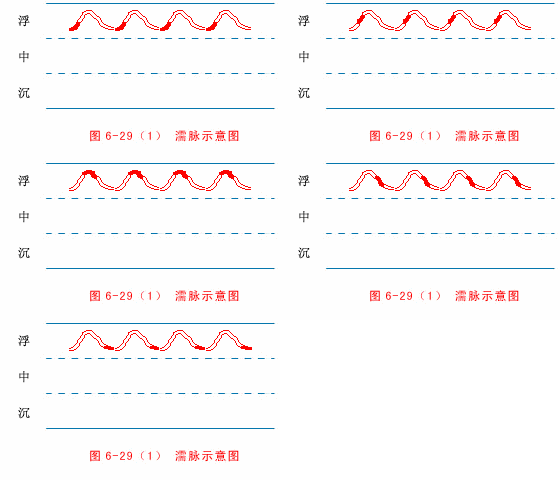
濡脉细软,见于浮分;举之乃见,按之即空。
Clinical Indications (主病歌)
濡主阴虚,髓绝精伤。经络技巧公众号提示左寸见濡,健忘惊悸;右寸见濡,腠虚自汗。左关逢之,血不营筋;右关逢之,脾虚湿浸。左尺得濡,精血枯损;右尺得之,火败命乖。
Clinical Significance
The Soft Pulse indicates yin deficiency, dampness encumbrance, and essence-blood depletion. It is floating, fine, and soft, felt with light pressure but empty when pressed more deeply. It forms when yin blood is deficient and vessels lose filling, or when dampness suppresses yang qi so that qi and blood cannot fill the vessels. Because it appears in the floating position, it often indicates exterior deficiency or yin deficiency with dampness. At the left inch position, soft pulse indicates heart yin deficiency with forgetfulness, palpitations, and insomnia. At the right inch, it reflects insecure defensive qi with spontaneous sweating and susceptibility to wind-cold. At the left guan, it points to liver blood insufficiency with muscle cramps, numbness, and blurred vision. At the right guan, it indicates spleen deficiency with dampness encumbrance, presenting as abdominal fullness, poor appetite, loose stools, and heavy limbs. At the left chi, it reflects kidney yin and essence-blood depletion with weak lower back and knees, seminal emission, and tinnitus. At the right chi, it indicates decline of the life gate fire with aversion to cold, edema, impotence, and a generally poor prognosis. Environmental dampness and living conditions significantly influence the presentation and persistence of the soft pulse, and the skin may feel clammy while the tongue often shows a greasy coating in dampness-related cases.
Treatment and Care
For yin deficiency with a Soft Pulse, nourish yin and blood; for dampness encumbrance, strengthen the spleen and transform dampness. Heart yin deficiency is treated with Tian Wang Bu Xin Dan or Suan Zao Ren Tang. Insecure defensive qi is treated with Yu Ping Feng San or Mu Li San. Liver blood deficiency is treated with Si Wu Tang or Bu Gan Tang. Spleen deficiency with dampness is treated with Shen Ling Bai Zhu San or Xiang Sha Liu Jun Zi Tang. Kidney yin deficiency is treated with Liu Wei Di Huang Wan or Zuo Gui Wan. Decline of the life gate fire is treated with You Gui Wan or Jin Gui Shen Qi Wan. Daily care emphasizes avoiding damp environments and wearing dry clothing. The diet should be light and warm; for spleen deficiency with dampness, eat coix seed, red beans, Chinese yam, and poria to strengthen the spleen and drain dampness; for yin deficiency, eat white fungus, lily bulb, black sesame, and goji berries to nourish yin and blood. Avoid raw, greasy, and sweet foods that assist dampness. Moxibustion at Zu San Li, Yin Ling Quan, and Pi Shu strengthens the spleen and drains dampness, while moxibustion at Shen Shu and Guan Yuan warms yang and secures the root.