Traditional pulse reference
Flooding Pulse
Flooding
A terminology and study guide for the traditional description, comparison points, and safety limits of this pulse quality.
Reader guide
A pulse term is not a diagnosis
Traditional pulse descriptions are educational terminology. A pulse finding can vary with pressure, rate, position, posture, activity, medication, age, and the examiner's technique. It must be interpreted with a complete history and examination.
Reviewed by Kuda, September 2, 2026 - Editorial policy
TACTILE DESCRIPTION
How the Pulse Is Described
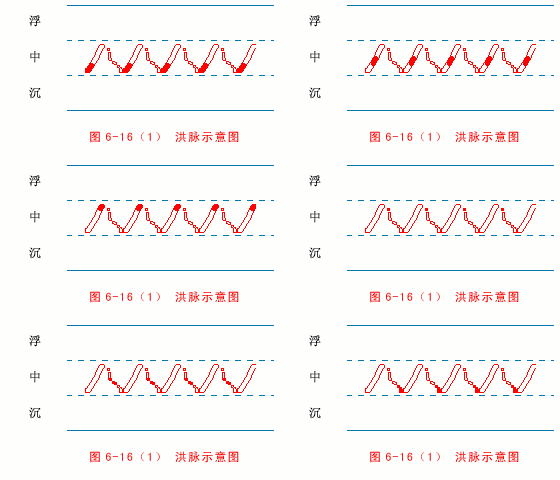
A flooding pulse feels broad and forceful on arrival, then less full as it recedes.
Traditional discussions place it in intense heat or exuberance contexts and emphasize the risk of fluid depletion.
CLASSICAL CONTEXT
How Traditional Texts Frame It
The flooding quality is described as broad and forceful on arrival with a weaker retreat. Classical texts place it in intense heat and fluid-consumption contexts.
DIFFERENTIATION
What to Compare
Compare flooding with full and rapid by observing the rise-and-fall quality, width, and force. A forceful pulse after activity is not enough to establish a flooding pattern.
- Record pressure level, rate, regularity, width, and strength instead of relying on one label.
- Interpret the pulse alongside symptoms, history, medication, age, posture, stress, and recent activity.
- Do not convert a traditional pulse term into a modern diagnosis without appropriate examination.
COMMON COMBINATIONS
Related Qualities in Study Notes
Flooding-rapid, flooding-full, flooding-floating, and flooding-empty are common classroom contrasts. Fever and dehydration need measured clinical evaluation, not pulse interpretation alone.
These are terminology pairings used for reading and comparison, not formulas, dosing instructions, or treatment recommendations.
SAFETY BOUNDARY
When Not to Rely on a Pulse Record
High fever, dehydration, confusion, or a rapid deterioration requires urgent care.
Pulse education can explain terminology, but it cannot replace an ECG, laboratory testing, imaging, or an in-person clinical assessment.