Traditional pulse reference
Tight Pulse
Tight
A terminology and study guide for the traditional description, comparison points, and safety limits of this pulse quality.
Reader guide
A pulse term is not a diagnosis
Traditional pulse descriptions are educational terminology. A pulse finding can vary with pressure, rate, position, posture, activity, medication, age, and the examiner's technique. It must be interpreted with a complete history and examination.
Reviewed by Kuda, September 2, 2026 - Editorial policy
TACTILE DESCRIPTION
How the Pulse Is Described
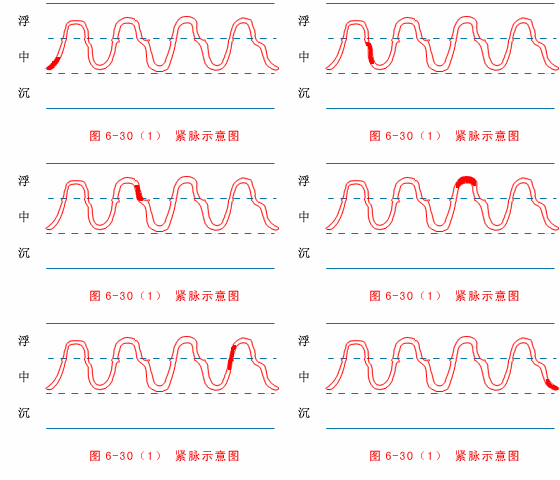
A tight pulse feels tense and forceful, often compared with a twisted cord or a stretched wire.
Traditional contexts include cold and pain, but the location and associated qualities matter.
CLASSICAL CONTEXT
How Traditional Texts Frame It
Tightness is traditionally compared with a twisted cord and linked with cold or pain. It is a texture and tension description, not a direct measure of muscle spasm or inflammation.
DIFFERENTIATION
What to Compare
Compare tight with wiry: both are tense, but tight is more constricted and changeable in the classical account. Add rate and depth before interpreting the finding.
- Record pressure level, rate, regularity, width, and strength instead of relying on one label.
- Interpret the pulse alongside symptoms, history, medication, age, posture, stress, and recent activity.
- Do not convert a traditional pulse term into a modern diagnosis without appropriate examination.
COMMON COMBINATIONS
Related Qualities in Study Notes
Tight-slow, tight-floating, tight-deep, and tight-rapid combinations are used in study notes. Sudden severe pain or chills should be assessed independently.
These are terminology pairings used for reading and comparison, not formulas, dosing instructions, or treatment recommendations.
SAFETY BOUNDARY
When Not to Rely on a Pulse Record
Sudden severe pain, chills, chest pain, or abdominal pain requires medical assessment.
Pulse education can explain terminology, but it cannot replace an ECG, laboratory testing, imaging, or an in-person clinical assessment.