Traditional pulse reference
Full Pulse
Full
A terminology and study guide for the traditional description, comparison points, and safety limits of this pulse quality.
Reader guide
A pulse term is not a diagnosis
Traditional pulse descriptions are educational terminology. A pulse finding can vary with pressure, rate, position, posture, activity, medication, age, and the examiner's technique. It must be interpreted with a complete history and examination.
Reviewed by Kuda, September 2, 2026 - Editorial policy
TACTILE DESCRIPTION
How the Pulse Is Described
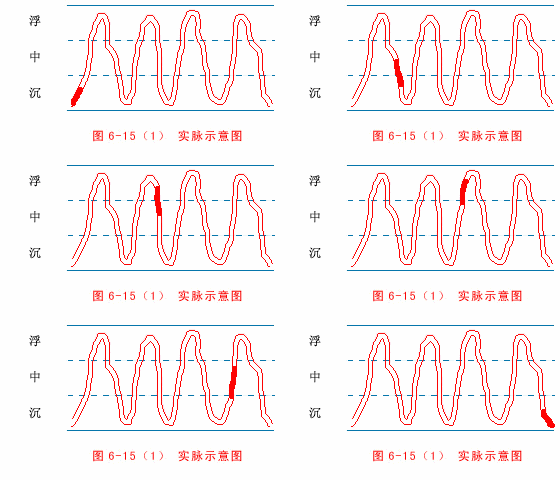
A full pulse remains strong across light, medium, and deep pressure.
Traditionally, this suggests an excess presentation, but strength can also reflect recent activity, stress, pain, or medication.
CLASSICAL CONTEXT
How Traditional Texts Frame It
A full pulse remains present across pressure levels and is traditionally associated with excess presentations. Strength can also change temporarily with exertion, pain, stress, or stimulants.
DIFFERENTIATION
What to Compare
Compare full with flooding, wiry, tight, and rapid qualities. Ask whether the strength persists at depth and whether the rhythm is regular rather than using “strong” as a complete interpretation.
- Record pressure level, rate, regularity, width, and strength instead of relying on one label.
- Interpret the pulse alongside symptoms, history, medication, age, posture, stress, and recent activity.
- Do not convert a traditional pulse term into a modern diagnosis without appropriate examination.
COMMON COMBINATIONS
Related Qualities in Study Notes
Full-rapid, full-deep, full-tight, and full-wiry are standard comparison sets. Their traditional meaning depends on the symptoms and stage described in the source.
These are terminology pairings used for reading and comparison, not formulas, dosing instructions, or treatment recommendations.
SAFETY BOUNDARY
When Not to Rely on a Pulse Record
High fever, severe pain, abdominal distension, or altered consciousness requires urgent evaluation.
Pulse education can explain terminology, but it cannot replace an ECG, laboratory testing, imaging, or an in-person clinical assessment.