Herb reference entry
Evodia Fruit / Tetradium Fruit
Evodia Fruit / Tetradium Fruit
Tetradium ruticarpum (A.Juss.) T.G.Hartley(Evodia rutaecarpa)
Reviewed by Kuda, September 2, 2026 - Editorial policy
OVERVIEW
What This Record Covers
Evodia Fruit, called Wu Zhu Yu, is the dried fruit of Tetradium ruticarpum, formerly often listed as Evodia rutaecarpa, a small tree of the rue family (Rutaceae) cultivated across central and southern China. The medicinal material is the cluster of small reddish-brown follicles with a strong pungent aroma, harvested before full maturity and dried for use. In trade it appears as whole fruit clusters, broken pieces, powders, granules, and combined formulas. Because botanical synonyms and fruit maturity vary, the species and the harvest stage should be recorded on the label.
- English name
- Evodia Fruit / Tetradium Fruit
- Latin name
- Tetradium ruticarpum (A.Juss.) T.G.Hartley(Evodia rutaecarpa)
- Traditional category
- Interior Warming
- Nature
- Hot
- Flavor description
- Pungent, Bitter
- Record identifier
- wuzhuyu
IDENTIFICATION
Identification and Image Notes
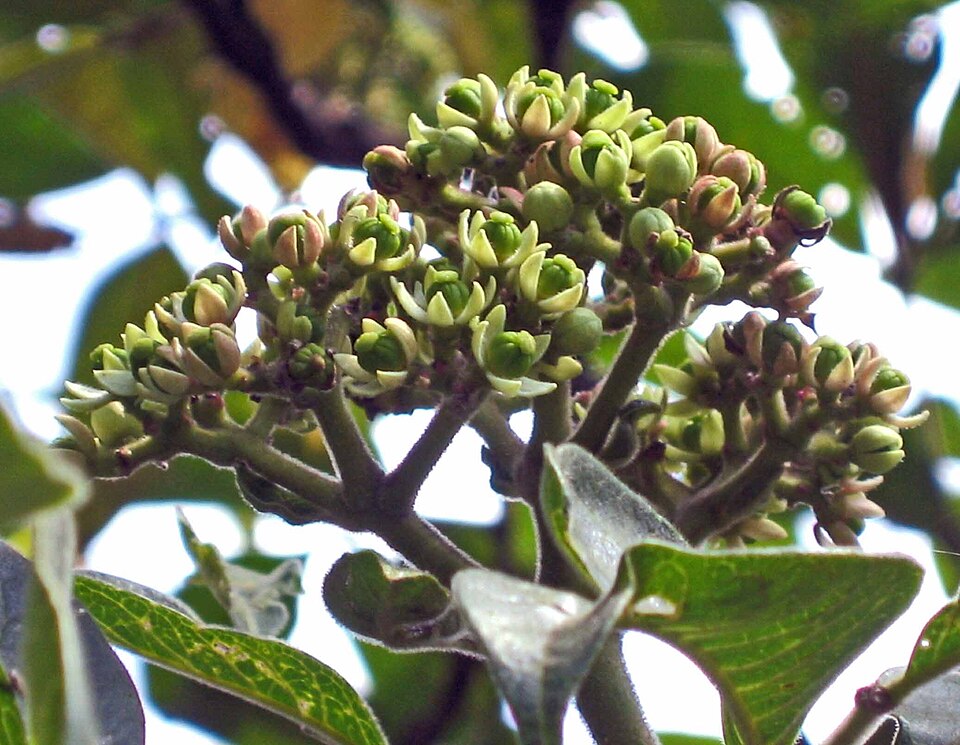
The fruit is a cluster of small reddish-brown follicles with a strong pungent aroma, and botanical synonyms and fruit maturity should be recorded. The dried follicles are small, hard, and wrinkled, with a sharp, peppery smell and a numbing, pungent taste, and they are usually sold as whole clusters. The clustered follicle form is an orientation clue, but the species and the harvest stage should be confirmed with the label, and powder products need stronger traceability.
Images are for orientation only, not definitive species authentication; confirm species, part, source, and labeling with a qualified professional or authoritative monograph.
TRADITIONAL CONTEXT
Traditional Use in Context
Traditional records discuss Evodia Fruit for warming the liver and stomach, vomiting, headache, cold pain, and downward movement, and it appears in classical formulas such as Wu Zhu Yu Tang for headache and vomiting with a cold presentation, and in combinations with Ginger and Dried Ginger for nausea, and it is used externally in some historical salt-based preparations. Classical texts describe it for cold-type vomiting and headache, always within a pattern-based framework. The warming vocabulary is historical, and severe headache, vomiting, or abdominal pain requires medical assessment rather than strong warming products. Recurrent vomiting with dehydration, blood, or neurological signs needs urgent evaluation.
PROCESSING CONTEXT
Raw Material, Processing, and Product Form
Fruit is dried and may be processed with vinegar or another auxiliary material, and powder and extract products need stronger traceability because the taste and exposure are concentrated. Each processed form is a separate record.
The same name can cover a raw material, decoction piece, powder, extract, or finished product, so record the labeled form rather than assuming it; see the safety review for the questions to ask.
SAFETY REVIEW
Safety Boundaries
Review pregnancy, hypertension, liver disease, gastrointestinal irritation, and allergy, and check the concentration of any extract product. Severe headache, vomiting, or abdominal pain needs medical assessment rather than strong warming products, and this page is educational and is not a dose recommendation.
This record is not a dose recommendation; risk depends on identity, preparation, amount, duration, contamination, other medicines, and health conditions — a traditional or “natural” label cannot establish safety. For the full framework, read the Chinese Herbal Medicine Safety Review.
COMPARISON
How This Entry Differs
Compare Evodia Fruit with Dried Ginger and Cinnamon Bark for warming direction, fruit versus rhizome or bark identity, and stronger irritation concerns. Evodia is the fruit of a small tree and the most pungent-irritating of the three. The small clustered fruit is easy to underestimate because its pungency is concentrated in a tiny volume.
Use the related-entry links below to compare identity, part, processing, and safety boundaries — similar categories do not make materials interchangeable.
STUDY METHOD
New to these entries?
Read the four-step method in How to Read a Herb Entry before comparing materials.